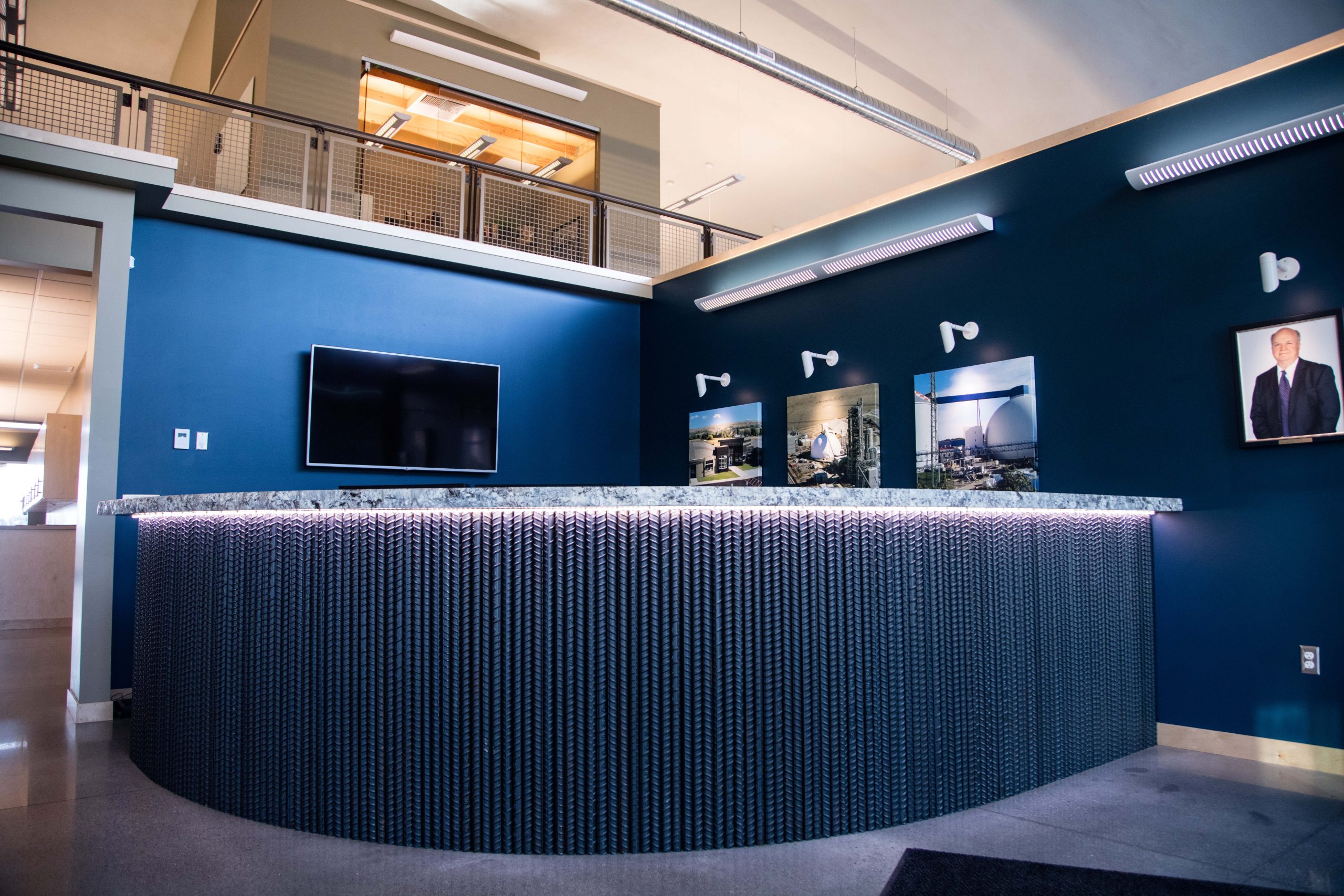
Dome Technology’s previous corporate office was a dome—an obvious choice since that’s what the company has been building for 40 years.
But since the office was built in the mid-1980s, the technology was outdated, the building was aging, and natural light was lacking. Management knew a new facility could be an asset for business, both internal and external.
“We wanted to be able to show people what we could do. We bring in people from all over the world to meet with us, and we needed an upgrade,” said Daren Wheeler, who acted as project manager for the new office.
The company builds bulk-storage and architectural domes all over the world and specializes in customized solutions to meet customer needs. Since “technology” is part of its name, Dome Technology sought an architectural style that would complement its cutting-edge engineering and construction. “It’s a modern office with an industrial flair,” Wheeler said, adding that visitors can’t help but notice the open freespan area.
That freespan is made possible in part based on shotcrete construction. Shotcrete was the primary structural component for construction, and the shotcrete work followed Dome Technology’s standard application process: A round airform was inflated, and polyurethane foam insulation was applied inside, forming a layer two inches thick. To the foam, workers applied a network of two-inch-square metal plates called stickers with rods attached to their centers. A final layer of foam insulation was applied, with premat steel reinforcing placed on top and connected to these sticker rods.
With this foundation, the dome was ready for shotcrete. Multiple applications of shotcrete and steel rebar were applied until necessary thickness was achieved and the dome was superior in its strength.
The continuous concrete shell protects the interior from external precipitation and provides necessary strength that complements the dome’s double curvature, resulting in a self-supporting structure free of interior supports.
“The biggest (advantage) with a concrete dome in an architectural application is there’s no interior load-bearing walls. Down the road, there’s virtually nothing stopping you from changing the entire interior,” Wheeler said.
The shotcrete dome coupled with the waterproof membrane counters common breakdown issues in concrete resulting from lack of insulation, extreme temperature fluctuations, and exposure to water. With the way it’s built, “there’s no limit to the life span to this building,” Wheeler said.
Burns Concrete of Idaho Falls, Idaho, USA, provided the shotcrete for the project, an easy choice based on a long-term working relationship between the two companies. “They’re really on the cutting edge of mix designs, so they fit our style of construction very well, and they have good quality-control measures in place,” Wheeler said.
Two noteworthy features in the office are the heating and cooling systems, both of which are housed within the concrete. All heating is achieved through in-floor radiant heat with hot water routed through the floor in multiple zones for flexibility in climate control.
The innovative cooling system is radiant too. According to Justin Judy, a principal at Engineering Systems Solutions (ES2) who performed engineering on the project, cooling begins with the concrete shell absorbing heat. “As lights are turned on, as people are in the building, and as computers are turned on, that heat rises, and the shell acts as a thermal battery. It essentially collects that heat, so you don’t necessarily have to air condition the building because the heat is going into the shell,” Judy said.
Because the shell holds heat exceptionally well, coming up with a way to discharge the energy was necessary. The ES2 team designed a system that circulates 55-degree Fahrenheit (12.8 degrees Celsius) ground water from an exterior well through three miles of PVC tubing routed within the shell. As the water flows through the shell, it collects the heat, then returns to the aquifer through an injection well. “We aren’t paying to air condition a large portion of the dome because we’re using ground water to do it,” Judy said.
Besides long-term cost savings, the heating system provides an ideal work environment for employees. “Particularly with all the openings we have, it’s pretty remarkable we can stay as warm as we do with just the radiant heating,” said Dome Technology Vice President of Sales Rod South. “Because the dome shell and the floor are integrated into one concrete thermal mass and we have the radiant heating throughout, it stays nice and toasty through the winters,” which can dip to 20 below zero Fahrenheit (-28.9 degrees Celsius).
The heating and cooling systems provide an effective way to show potential customers the efficiency of heating and cooling a dome. “Just having the concrete building reduces your cooling costs in the summer because it absorbs the heat,” Wheeler said.
To further push aesthetics, the dome was finished with windows that provide views from every angle. “Because there are no (structural) walls, the office feels very open and very big, and it feels like there’s no sense of confinement, particularly with so much glazing and since you can see from end to end and what’s in front of you and what’s behind you,” South said.
Dome Technology builds domes of varying geometries, and the corporate office showcases an elliptical dome that’s better acoustically and aesthetically.
“We feel really proud to be able to show people the office. It’s a highlight of our shotcrete work, and it also stands to show what we’re capable of. Because this dome is nicely finished, (customers) have an inherent trust that what we’re going to deliver to them is going to be a quality product as well,” South said.